Entertainment
MacKenzie Thomas Is The E-Girl Supreme
She doesn’t believe in “oversharing.” She isn’t afraid of her digital footprint. And she may have just inspired Justin Bieber’s Coachella performance.
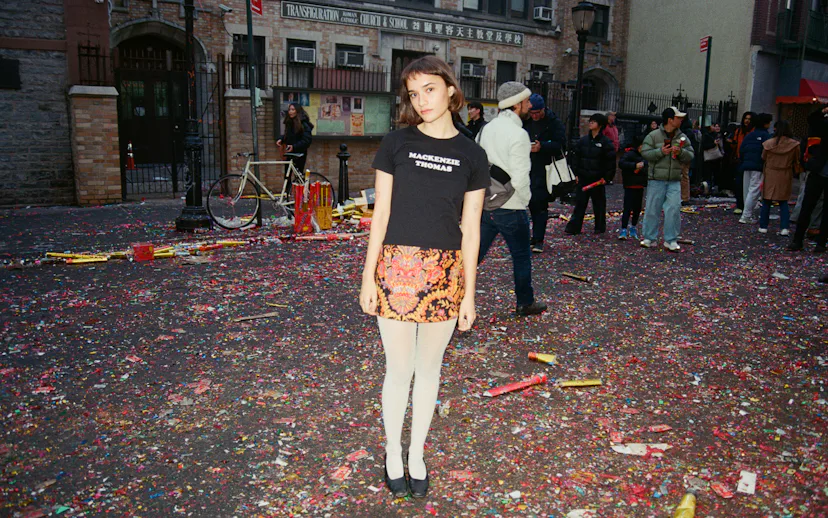
Mackenzie Thomas is the kind of person you feel like you already know, without knowing why.
When I first encounter Thomas IRL, she’s posted up on a bench in Brooklyn’s Maria Hernandez Park, recounting tales of unrestricted childhood Internet access and formerly running a Bill Hader fan page. She is actively keeping an eye out for the elusive “tea guy” from whom she often purchases homemade concoctions and has subsequently befriended as a result of her frequenting the Bushwick hub. Her trademark brunette bob and baby bangs are in perfect tact, the relics of a signature silver manicure glinting. She seems to know everyone in her Brooklyn enclave: friends materialize midsentence, strangers become acquaintances, acquaintances become lore. Her cadence is shaped by poetic eloquence and her humor is meme-ably sharp, constantly flickering between confession and punchline.
“I don’t think there’s a lot of mystique to me. If you want to know what’s up with me, it’s all online,” says Thomas. “I am not being anybody but myself, so if you f*ck with what I’m doing, we’ll probably become friends.”
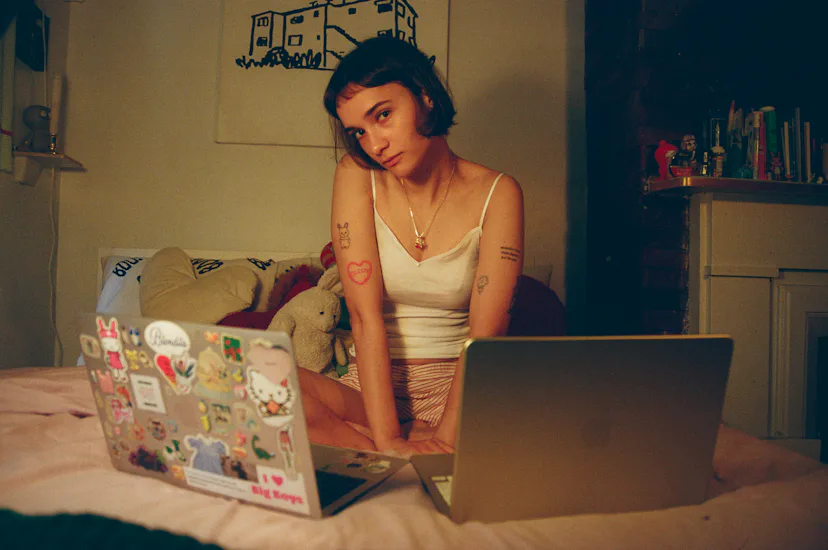
Though we’ve only met briefly in person, I, like many, feel well-acquainted with her presence thanks to her primary stage: the Internet. “Truly, I’m an e-girl,” she says matter-of-factly. “I have a true love of the game. The game being the Internet.”
To the less chronically online, it’s difficult to pinpoint what exactly Thomas does, because she is renowned for her mere existence. She reads her melodramatic teenage journal entries on TikTok. She dances alone in photobooth videos. She lip-syncs to music on city streets with a 4-foot selfie stick. She waxes poetic on her own introspections via Substack. And she tweets… a lot.
“The most ever present forces in the universe are God, air, and the Internet,” says Thomas without hesitation.
Along the way, the 27-year-old creator has racked up hundreds of thousands of followers across platforms and generated a fan base that projects its own fragmented experiences of girlhood onto her, admiring her uninhibited humanity online.
Is it performance art? No. Is it TikTok diarism? Well, not exactly that, either. From her first introduction at 8 years old to YouTube from a “scene babysitter,” to viral TikToks documenting her Goodwill employee era in L.A. and the gradual accumulation of a distinctly self-authored online mythology, Thomas has resisted clean categorization aided by her instinctual documentation. The varied content that persists is underscored by pure wit, delivered with the ease of someone who has been narrating her own life long before anyone else was watching.
“I’ve had the urge to perform my whole life,” says Thomas. “I was really lonely as a younger person, and I had nobody to have inside jokes with, so I started having inside jokes with myself and posting them online. Now I have a bunch of inside jokes with people I’ll never know, and that’s such a blessing.” These include self-referential bits alluding to her fictional corporation, Mackenzie Thomas Industries; her love for Robert Pattinson; New Jersey state pride; and the term “playboy” to describe manipulative men she knows, folded back into her own canon in classic e-girl form.
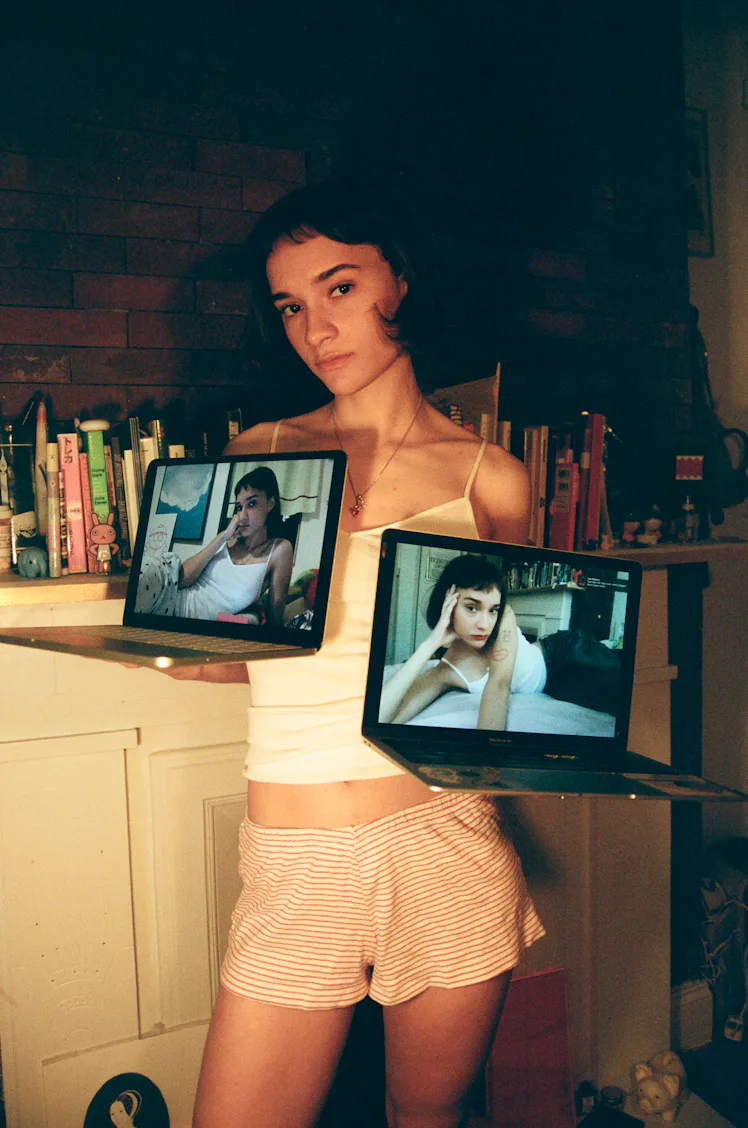
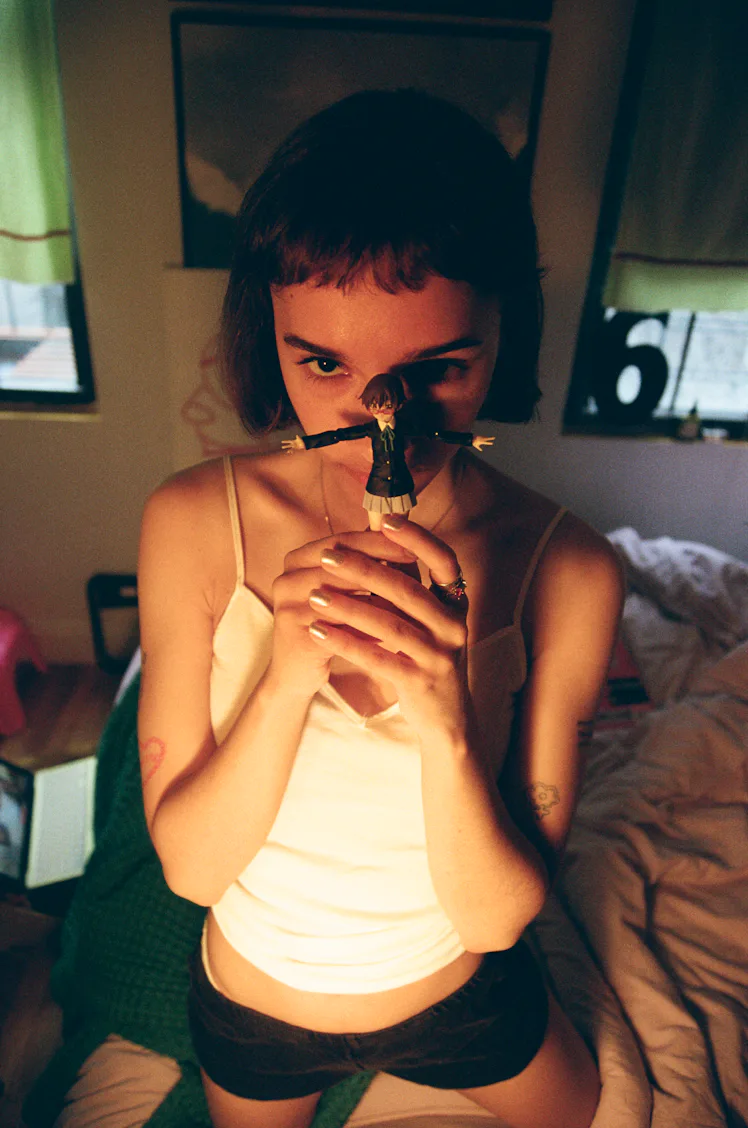
Like outdated and flattened millennial terms such as “girlboss,” the term “e-girl” has become both overused and underdefined in recent years. However, unlike the Dasha Nekrasova and Cat Marnell of yesteryear, Thomas exists in a looser Internet ecosystem shaped less by subculture than by proximity, overlap, and shared circles. Her world is populated by frequent collaborators and friends like burgeoning photographer Taryn Segal and rising comedian Ivy Wolk, forming an intentional coterie that moves together between performance, digital footprint, and their New York orbit.
Her frequent collaborations with friends bleed seamlessly into her own work, collapsing the distance between life and output. This same instinct to document, revisit, and rework inspired her one-woman show, I Said What I Said. It’s the result of her attempting to trace a throughline within a difficult year, writing it voraciously in a six-week sprint using her own posts as source material. “I’m able to take my digital footprint and collapse it onto itself and make it into something new,” says Thomas. “My greatest embarrassments have always been my greatest victories, and if I wasn’t posting about everything online, I wouldn’t have the opportunity to do that.”
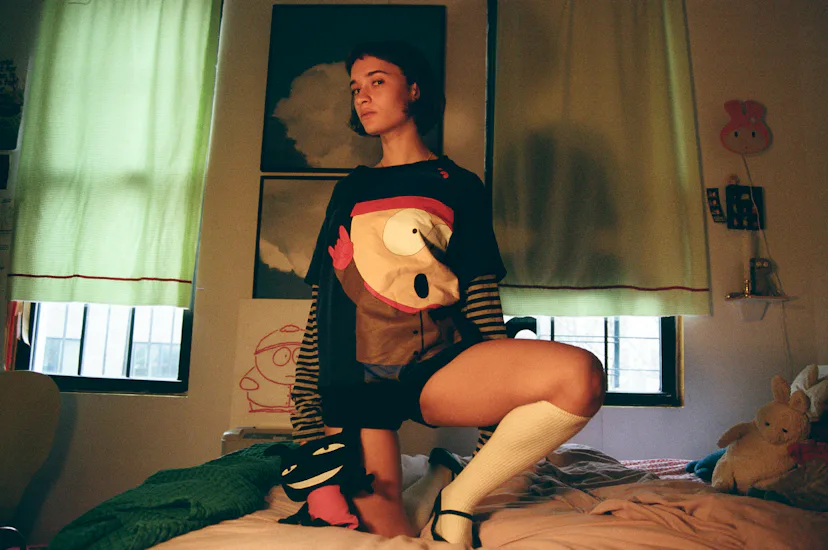
Throughout the four-hour production (with one strictly timed 15-minute intermission!), Thomas recounts the last taxing year of her life, from breaking up with an abusive ex on New Year’s Day to set the tone, to finding out her dog died via a phone call, dealing with the realities of an eating disorder, toiling in the lows of a situationship, and coming to terms with tortured parental dynamics. “It’s a show about love and all of its forms,” says Thomas. Entirely self-funded and staged across independent theaters — most recently performed earlier this month at A.R.T./New York Theatres in Hell’s Kitchen — the writer-performer sits behind a desk in front of a screen projecting her 2025 Twitter feed, a staging that eagle-eyed Internet acolytes later claimed was echoed in Justin Bieber’s recent Coachella performance. (For the record, Thomas estimates the odds he copied her as “close to zero... not zero, but close.”)
In her performance, Thomas reads her Twitter feed month by month, peppered with memes for comic relief and retweeted lyrics from her favorite indie-rock band Rilo Kiley, and pairs each month with an essay recited like a monologue. (Except, that is, for March, her least favorite month. At that time, she opens the floor to audience questions). For a generation notorious for fractured attention spans, the durational format becomes part of the bit. It feels like a collective scroll session, the crowd laughing at her hyperniche references and crying alongside her misfortune, landing us somewhere between a group chat and group therapy.
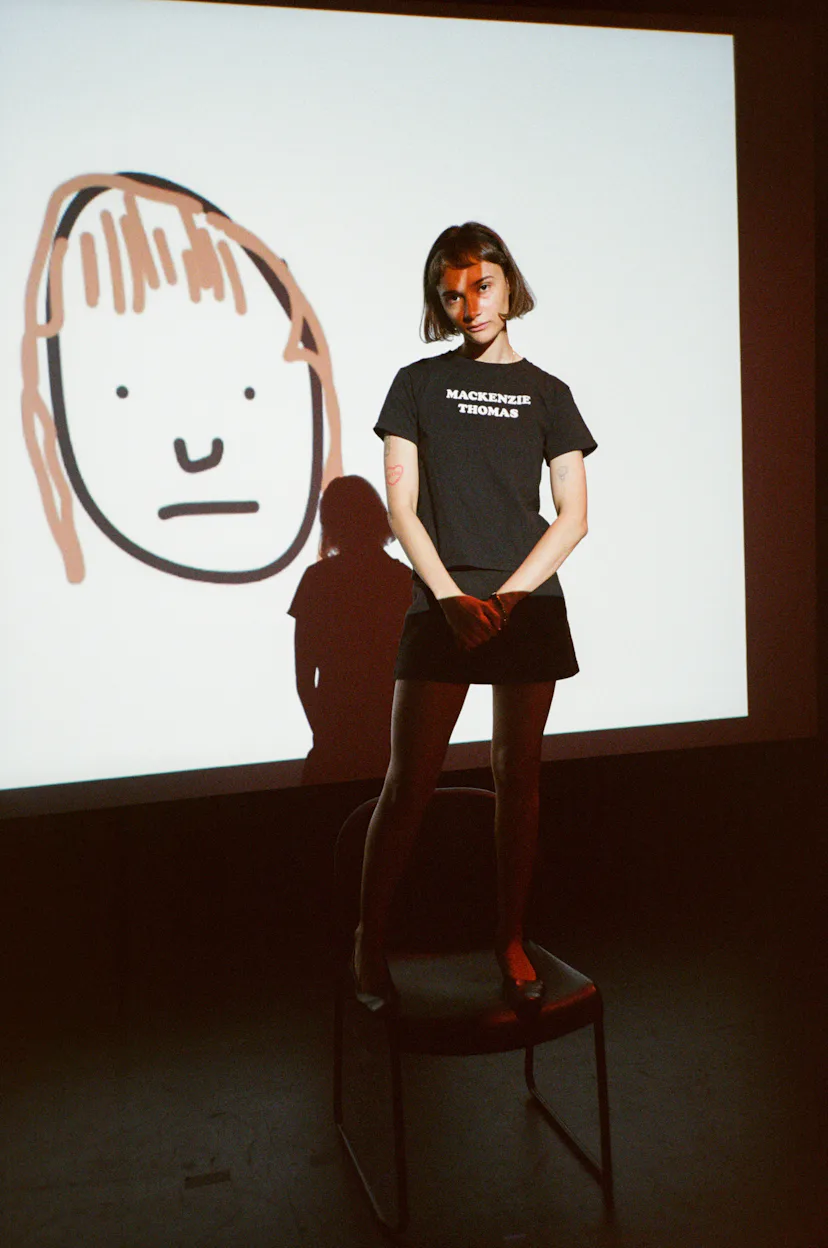
“I’m a sucker for a full-circle moment. My whole body of work is just me looking for a full-circle moment so I can be like, ‘OK, let’s move on,’” says Thomas. “In places where people find cringe within themselves is where I find catharsis.”
For those who missed her string of seven showings, it may be a minute before it resurfaces in the flesh — unless you’re willing to scroll back far enough on her Twitter feed. “[The show] takes a crazy emotional toll on me,” Thomas says of its difficulty to perform. “I hold nothing back, and I just need time away from it for a little bit.” She is open about the conditions of return: She would revisit the show again, but only if someone is willing to pay her to do it.
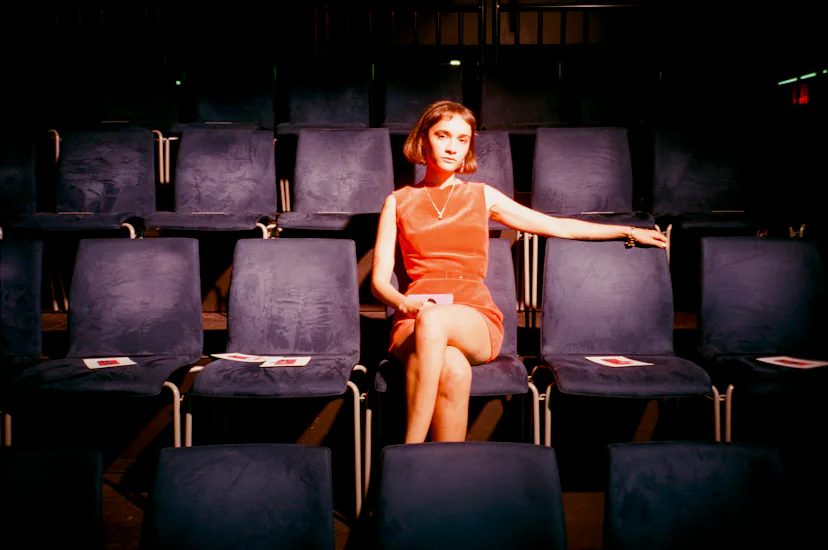
But fret not: You haven’t seen the last of Thomas yet. She teases a short film in the works, formulated by four years of videos recorded on her laptop (stored to her desktop, with no backups on an external hard drive), as well as a potential memoir (“I could never write anything fake,” she says). Her following continues to grow in tandem with her insistence on staying unpolished, drawn less to gloss than to the feeling of something unfiltered and emotionally legible. For now, she says she will keep funding her own practice the way she always has — moonlighting as an influencer when she can, collaborating with friends, and folding whatever she’s living through back into the work as it happens.
“I’m sure if the Internet didn’t exist, I’d be doing this in some other way, but it’s my weapon,” says Thomas. “It’s one of the only consistent things in my life.”
That, and Maria Hernandez Park, where we spot her friends on a nearby picnic blanket. They run over and confirm they received her Partiful invite to an upcoming night out. She gestures toward me and introduces me as her “friend.” I guess I do f*ck with her.
