NYLON Guys
The New Faces Of Party Rap
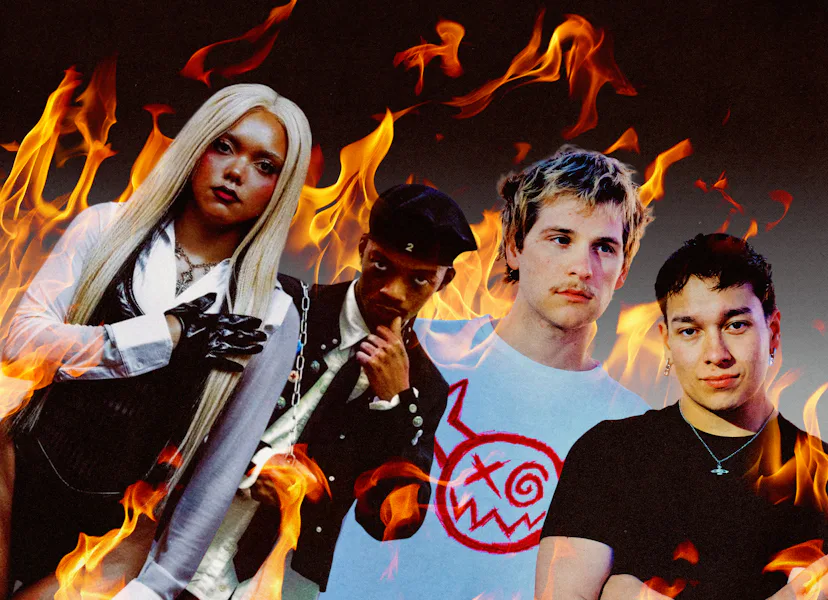
Acts like PartyOf2 and Joey Valence & Brae are revitalizing that Obama-era blend of hip-hop, pop, and electronic music with an earnest twist.
We all need to feel good about something. Perpetual war, climate doom, the threat of sentient AI, the hollowing out of the middle class, the crumbling of American democracy — where else to turn but to music, which has always drowned out our troubles? It’s against this backdrop that party rap — the raunchy, retro, slightly gimmicky fusion of hip-hop, pop, and electronic music that last peaked between the tail end of the Bush administration and the aftermath of the 2008 financial crisis — has reanimated, with acts like PartyOf2, Thot Squad, Joey Valence & Brae, and Bbno$ taking up the spirit of late-2000s genre-busters. Only this time, they’re shedding the in-crowd mystique and ironic packaging for something a little more honest and vulnerable.
In the mid-to-late aughts, as Myspace and blog culture tore down barriers between the mainstream and underground, artists like Spank Rock, Amanda Blank, and Kid Sister were dropping booty-shaking bass jams inspired by the club sounds of Baltimore, Philly, Chicago, and Miami; DJs like Diplo and A-Trak were bringing indie rock, club music, and rap into one boisterous world with their Hollertronix parties and Fool’s Gold Records, respectively; and mashup artists like Girl Talk and Super Mash Bros were bringing genre lines down with them. The creative freedom the era afforded was not lost on anybody. This was party music made with a wink.
Back then, the Internet made plenty of scenes accessible, but for the most part, you still had to know where to look. Now, perhaps because we’re in a streaming ecosystem where everything is up for grabs at all times, that wink is less of a priority — something PartyOf2 has made clear.
Jadagrace and Swim, the ex-child stars who make up PartyOf2, used to be in a collective called Grouptherapy. (with former members TJOnline and Rhea). The lineup and name changed, but their playlist-on-shuffle omnivorousness remains, as does a healthy grasp on their feelings: “Another question from my therapist / ‘Are you good?’ I told her, ‘Yeah,’ she said, ‘Hilarious’ / I blew a tire on the road to riches I desire,” Swim raps on “Survivor’s Remorse,” from from last fall’s Amerika’s Next Top Party! LP. You can clearly pick out who they’re channeling at any given moment — a little Tyler, the Creator; a little Doechii; a little Missy and Timbaland — but what’s striking about the way they put it together is their disregard for corniness. Whereas Amanda Blank once rapped “I keep it dirty, I ain’t Fergie, f*ck the Black Eyed Peas,” today, PartyOf2 would take such a comparison as a compliment. In interviews, they’ve spoken of openly admiring the “I Gotta Feeling” stars’ inimitable hitmaking and studying “the chemistry between Will.I.Am and Fergie.” You can easily picture it on “Just Dance 2,” an obvious pastiche of dance-rap hybrids of the ’80s and ’90s. It’s a little cheesy, but it aims to be undeniable enough that you won’t care either.
Operating in a similar, though more playful, flirtatious space is Thot Squad, the alter ego of rapper Blvck Bunnie, with the assistance of her producer husband, Benny Ari. Thot Squad exists almost entirely in the lane paved by Spank Rock, cooking up songs like “Pound Cake,” “Hoes Depressed,” and “Super Soaker”; come-one-come-all is their ethos in more ways than one. Yet their unrelentingly horniness and contagious lack of self-consciousness have found a wide array of fans. “We’ll get people who are like, ‘Well, I’m 47 and I’m a mom. I don’t think I’m gonna fit in. Everyone in my crowd is 47 and a mom,’” Bunnie said in an interview last year. This is music about loving yourself and embracing the quirks that make each of us unique. In less risqué packaging, it might come across more cliché — but here, it’s both very genuine and an absolute ball.
Without an oppressive masculinity coursing through it, there’s something even hopeful about what they’re making at a time when Gen Z men are leaning right.
If you’re looking for a more straightforward delivery of those messages, Joey Valence & Brae might be for you. The duo’s 2025 album Hyperyouth (which just came out in a deluxe edition, too) has turned them into minor celebrities in the alt-rap world. They’re cool enough to have gotten a cosign from JPEGMafia, who might have punched me in the face if I suggested a decade ago that he would appear on an album from these dudes. And yet, there he is, between features from TiaCorine (on “Bust Down,” which evokes early 2000s Neptunes productions) and Rebecca Black (on the Timbo and Nelly Furtado-inspired “See U Dance”). Fueled by a grab-bag of MTV-era references, Joey Valence & Brae blast down the line between goofiness and earnestness with a recklessness that suggests they don’t actually care which side they fall on.
On 2024’s “The Baddest,” they interpolate “It Takes Two” by Rob Base & DJ E-Z Rock — also a move out of the Black Eyed Peas playbook — and rap like they just discovered Urban Outfitters: “Acting goofy, Comic Sans / Big in London, big in France / Hot like Texas, I got fans / BDG overalls / Fresh new Vans.” It’s enough to make you swear ’em off for good, but then they cook up a song like “Changes” from Hyperyouth and it’s easy to see why — only so many years removed from the public pummeling of Macklemore — so many people are gravitating to this movement of unquashable positivity.
“And I found out what love is / And I found out what hate is / My parents getting older / I look at their faces,” Joey raps. It hits hard. So much of Hyperyouth is obsessed with chasing fun, desire, and presence in the moment. When the duo step back and identify the various voids they’re looking to fill, they are instinctively easy to root for. Joey Valence and Brae are both in their mid-20s, having spent some of their most formative years during the disruptive isolation of COVID-19; many of their generational cohort have never known an office job or the usual infrastructure of young adulthood. It makes sense that their music is filtered through a strong desire for connection and mutual understanding. And without an oppressive masculinity coursing through it (“This DJ sucks, can you play some Gaga? Ah, what happened to the fun?”), there is something even downright hopeful about what they’re making at a time when Gen Z men are leaning right. We take our wins where we can get them.
The highs are high, but the lows are right outside, knocking on the door.
Hope is perhaps not the emotion one feels like listening to Bbno$ (that’s baby-no-money for the elder millennials). He got his start as a TikTok sensation, blowing up alongside his dear friend Yung Gravy (whose name rolls in like a tumbleweed from an already bygone Internet). Bbno$’s songs rack up hundreds of millions of streams and sound like what LMFAO might have sounded like had they a shred of self-awareness, or even pretended to. If you’re going to be cynical or suspicious of this 2020s class of party-positive artists, it’s probably because of someone like Bbno$, who takes joy in making rap music that proudly embraces the lowest common denominator. With Joey Valence & Brae, Thot Squad, and PartyOf2, the desire to make music they genuinely think is good is apparent; Bbno$, on the other hand, sometimes raps with the detachment of someone doing a performance-art imitation of a rapper.
That was the case, at least, until he released “Why Am I Like This” in March, which seemingly asked the question many of his haters were asking while listening to the sexed-up hedonism of previous releases like “Come to Brazil,” “Gigolo,” and “1-800.” It’s one of the clearest moments of introspection from Bbno$, and it works precisely because it jars against the nothing-matters nonchalance of much of his discography. “My parents getting old / And I rarely visit home / I should get off my phone / But I’m scared of being alone,” he sings. (Notice a theme?) It might not be his biggest hit — though it is inching toward 3 million Spotify streams — but it contextualizes his work, offering a lens through which his fans can genuinely relate.
It’s something that each artist plopped into this category of Party Rap 2.0 has in common. The highs are high, but the lows are right outside, knocking on the door. This is music meant for escaping from reality, but it’s all the more effective as a balm if it can also remind us of what we’re healing from. Whether you want to show up and dance, cry, or figure out what the hell is happening all around us, the club is open — and everyone’s invited.
