Life
How Tyler Santangelo Built a Gallery With a Point of View, and What’s Next
Five years in, ALLGORITHIM has moved with the tides of both a turbulent art market and its founder's own life. The new Perma Locum program builds on that conviction.
Art dealer and film producer Tyler Santangelo has spent the past five years building something the contemporary art world has rarely made room for: a gallery with a point of view. Los Angeles's ALLGORITHIM, founded in September 2021, has undergone substantial formal changes since its establishment — but its core position has held. At a moment when the art world is contracting, consolidating, and retreating behind the machinery of the fair circuit, ALLGORITHIM has moved in the opposite direction.
Reading The Room
The past several years have not been kind to the gallery ecosystem. Major institutions have cut staff and trimmed rosters. Blue-chip galleries have shuttered secondary spaces. The fair market, with its compressed viewing windows, transactional energy, and self-selecting collector base, has come to dominate how art is bought, sold, and discussed. For many emerging and early-career artists, meaningful representation has become harder to come by, not easier.
Tyler started ALLGORITHIM in part as a counter to that logic. The name itself references the algorithmic systems that have flattened cultural taste for a generation, curating by engagement rather than by conviction. ALLGORITHIM was always meant to be a space where work had to be encountered on its own terms, without a metric deciding whether it merited attention.

A Curatorial Practice Shaped By Life
ALLGORITHIM has also evolved for more personal reasons. Tyler spent his early years absorbing everything the Los Angeles art, film, and social world had to offer — until the accumulation itself became its own kind of noise. He stepped away, spending nearly a year in New York, as a way to think without the pressure of acting.
That period of withdrawal is legible in ALLGORITHIM's curatorial sensibility. The gallery has never chased the market's current obsessions. Its program, spanning painting, photography, mixed media, and works on paper, drawn largely from emerging and early-career artists, reflects a considered editorial eye rather than a response to what's selling at auction.
ALLGORITHIM House As Environment
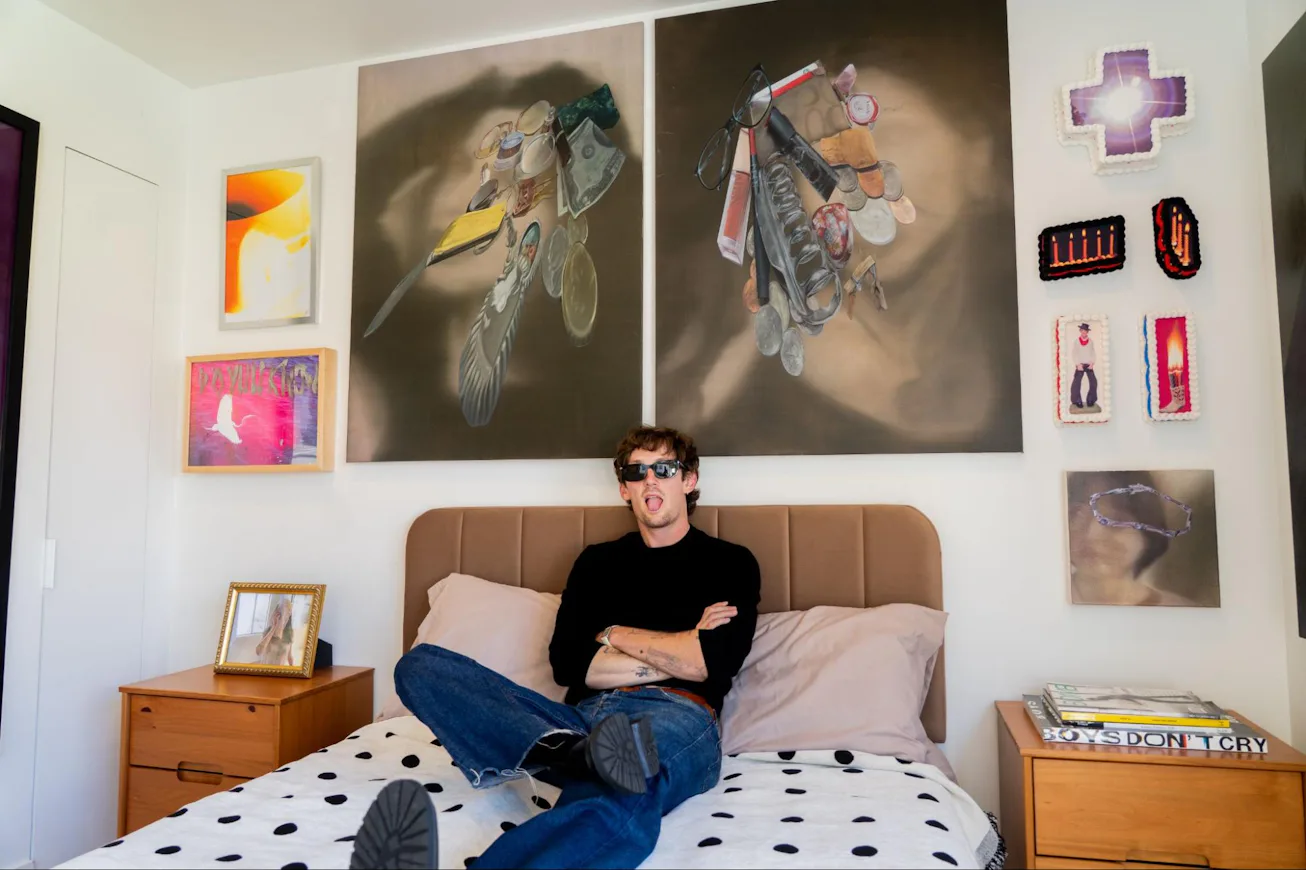
The shift to ALLGORITHIM House, a residential space in the Hollywood Hills, was less a reinvention than a refinement. In a climate where gallery real estate is either shrinking or consolidating into institutional-scale white cubes, Tyler moved the program into a lived-in space, asking collectors and visitors to encounter art the way it actually exists in the world: alongside furniture, within domestic scale, in rooms with history.
Three exhibitions have now defined that environment, each one extending the curatorial logic of the last. Collaged established the premise that ALLGORITHIM House would operate as a space for work that resists easy categorization, where medium and meaning are inseparable. Pictured, a group photography exhibition bringing together eleven photographers, sharpened that position: images made to be looked at slowly, in a context that rewarded attention over efficiency.
Layered, the current exhibition, carries that thinking furthest. Seventeen painters and mixed media artists are presented under a proposition that is at once formal and philosophical, that meaning accumulates, that identity forms through sediment, and that to layer is to refuse resolution. The works arrive carrying their own histories of marks and revisions. Together, as the exhibition's framing puts it, they form something less like a group show and more like a conversation already underway, one that the viewer steps into mid-sentence.
That context changes the viewing experience, and it was intended to. What ALLGORITHIM House has built across three exhibitions is not a brand identity but a curatorial argument, one that deepens with each iteration.

Perma Locum And The Longer Argument
The success of ALLGORITHIM House gave shape to Perma Locum, a lease-to-purchase program designed to move art directly from artists to high-net-worth individuals and corporations, removing layers of friction that have historically disadvantaged emerging practitioners. It is, in a sense, the same argument ALLGORITHIM has always made, extended into a new format: art should reach people in the spaces where they actually live and work, and artists should benefit materially from that access.
Perma Locum operates on two commitments held in equal weight. The first is curatorial; artists enter the program through a rigorous selection process, and each is given editorial representation, active promotion, and ongoing advocacy rather than just a listing and a percentage. The second is financial; artists retain ownership of their work throughout the rental period, receive regular disbursements from monthly rental income, and are paid promptly when a lease converts to a sale. The model carries no inventory and speculates on nothing. It is structured so that Perma Locum succeeds when the artists do.
The appetite for original art in corporate interiors, luxury residences, and high-end development has never been stronger. Perma Locum enters that moment with a program designed to meet it, connecting clients who want to live with significant work to artists whose practices merit that context, on terms that make ownership a path rather than a barrier.
Outside the gallery, Tyler continues to develop projects through 14 Sunset, one of the production companies behind Freud's Last Session, with new work currently in development.
The portfolio is wide, but the thread running through it is consistent. At a moment when the art world is asking whether the gallery model is viable at all, Tyler Santangelo's answer has been to make it more personal, more direct, and more deliberately itself.
BDG Media newsroom and editorial staff were not involved in the creation of this content.
