Life
How Meaghan Murray Utilizes Space As Oxygen
Architect Meaghan Murray on Where Embodied Experience Becomes Perception
What exerts the greatest influence often resists immediate visibility. Contemporary culture frequently privileges what can be easily recognized and clearly defined, while slower, less tangible dimensions of experience remain harder to hold. The visible and the unseen are always in conversation, shaping how space is felt.
Meaghan Murray’s work lives in this tension, viewing space as an active force that shapes the perceptual and emotional atmosphere of an environment.
A multidisciplinary artist and architect, she approaches space as both material and medium. Working across architecture, writing, photography, and freeform dance, her practice examines how space shapes perception and how it can hold complexity without forcing it into form.
“Space isn’t emptiness,” she says. “It’s capacity. Our environments are active, shaping us as much as we shape them. I don’t think our culture fully understands that potential yet, or how much of our lives it influences.”

For Murray, space is not limited to physical form. It operates across perceptual, emotional, and temporal dimensions, often preceding conscious awareness. Material becomes central to this understanding, quietly modulating the emotional register of a space. Certain textures carry a sensual logic, shaping perception before it is consciously understood.
“Material restores depth to experience,” she says. “The body understands materials before the mind does. Touch is one of the last forms of knowledge that resists digitization.”
Yet these sensory and material dimensions are the least recognized or valued. Recognition tends to favor what is immediate, defined, and easily understood, while slower and less tangible dimensions of experience are overlooked. What cannot be quickly articulated or displayed is often treated as secondary, despite its measurable influence on how people live and relate.
Murray’s work resists this compression. Rather than prioritizing visibility, she focuses on cultivating the conditions that allow depth and complexity to remain intact.
“Every kind of work has a value system behind it,” she says. “In my practice, I refuse to let visibility stand in for substance.”

This position shapes not only what she creates, but how she creates it. Across disciplines, her work avoids premature resolution, allowing space for perception, emotion, and meaning to emerge. The emphasis shifts from producing immediate impact to supporting sustained experience, where what is felt carries equal weight to what is seen.
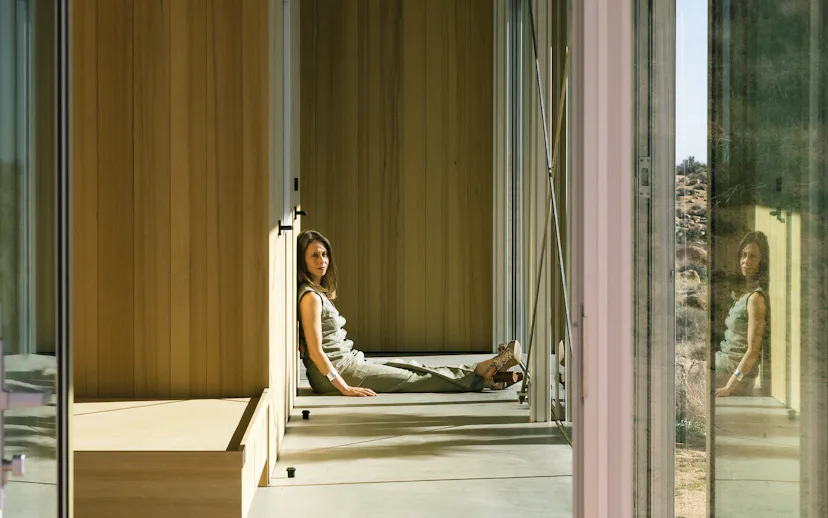
This sensibility becomes visible in her architectural work, where design emerges as a process of listening. Light, topography, and climate guide each project, allowing buildings to exist in direct relationship with their context. Rather than isolating occupants from the land, the architecture deepens their connection to it.
Off-grid dwellings respond to solar orientation, air movement, and seasonal variation. Materials are selected for their ability to weather and adapt over time, allowing the architecture to evolve alongside its environment. Landscape becomes an active participant in the work. The goal is not to dominate the landscape, but to enter into dialogue with it, allowing space to remain responsive, permeable, and alive.
That sensibility has shaped work that circulates widely across architectural and cultural platforms. Murray’s work has been featured in leading architecture and design publications, and she has served as an invited critic and reviewer at architecture and design schools in California and Canada. Her work has been recognized within the architecture and design community for advancing a distinctive spatial practice that bridges architecture, embodiment, and perception. Through her multidisciplinary methodology, she contributes to contemporary discourse on how built environments influence human experience.
Across her work, Murray returns to a central inquiry: how to give form to forces that cannot be seen, but are constantly felt. This begins with the recognition that space emerges through a continuous conversation between body and environment. Life itself is in constant motion, and it is this movement that makes perception possible.
This sensitivity is not only professional, but deeply personal.
“I’ve always been someone who values psychic oxygen,” Murray says. “When a dynamic starts consuming too much of my interior space, I feel it immediately.”

This awareness shapes how she moves through the world and how she works within it. Attunement becomes both a survival instinct and a design method, a way of recognizing when space supports life and when it begins to constrain it.
In dance, continuous motion brings greater awareness to moments of stillness, allowing them to be felt more fully. The apparent permanence of a photograph or a building does not stop movement, but creates a pause, offering space for meaning to emerge.
“I am driven to this tension,” Murray says, “between the fluid impermanence of life and the human impulse to give it form. My work plays in this tension rather than trying to resolve it.”
In 2020, this sensibility extended into Murray’s architectural work when she played a central role in the winning architectural competition proposal for a champagne brand within one of the world’s largest luxury groups, involving the restoration and re-envisioning of a 15,000-square-foot Brutalist pavilion embedded in the natural landscape of Napa Valley. Rather than introducing new elements, Murray focused on restoring the clarity of the original architecture while reorganizing circulation through a new accessible path. Dividing walls and accumulated layers were removed to reestablish openness and continuity. Tasting, dining, and retail programs were unified through continuous tile flooring, natural materials, custom furnishings, and softened finishes that connected the interior to the surrounding landscape. Through the careful use of material, color, texture, and light, the space was reshaped into an environment that restored the pavilion’s capacity to hold movement, perception, and shared experience. The project has been widely recognized within architectural circles for advancing a spatial approach that integrates environmental responsiveness with experiential design, reinforcing Murray’s growing reputation as a practitioner influencing contemporary thinking on the relationship between architecture, landscape, and human perception.
There is a paradox Murray recognizes immediately: the desire to make something last, paired with the knowledge that its beauty emerges from impermanence. In her hands, architecture becomes a way of honoring this paradox - a way of concretizing attention without denying movement. A pause that does not pretend to be permanent.
“To hold something still, even briefly, is not to fix it permanently, but to honor its presence,” Murray says.

In a culture optimized for immediacy, certainty, and display, Meaghan Murray’s work proposes a different measure of value. Her practice cultivates spatial conditions that hold complexity, depth, and lived experience. She asks, not how quickly something lands, but how much room it makes. Not how loudly it announces itself, but how deeply it is felt.
BDG Media newsroom and editorial staff were not involved in the creation of this content.
