Entertainment
The Finsta Renaissance Is Here
From Rachel Sennott to Addison Rae and Audrey Hobert, everyone has a secondary account now. It’s just a question of who’s watching.
There was a time when a finsta was sacred.
The finsta — or "fake Instagram," for those less acquainted — emerged as an antidote to the polished tyranny of the main feed sometime in the mid-2010s. Under private accounts with inconspicuous handles and profile pictures ripped from obscure memes existed a protected ecosystem of bad angles, inside jokes, and diaristic captions written at 2:17 a.m. While your primary account functioned as a carefully curated portfolio of who you wanted people to think you were, your finsta was reserved for who you actually were. But most importantly, it wasn't for everyone. The audience was intentionally small as a finsta was never trying to perform in numbers but simply make twelve people, give or take, laugh.
Which is exactly why celebrities are suddenly obsessed with them again.
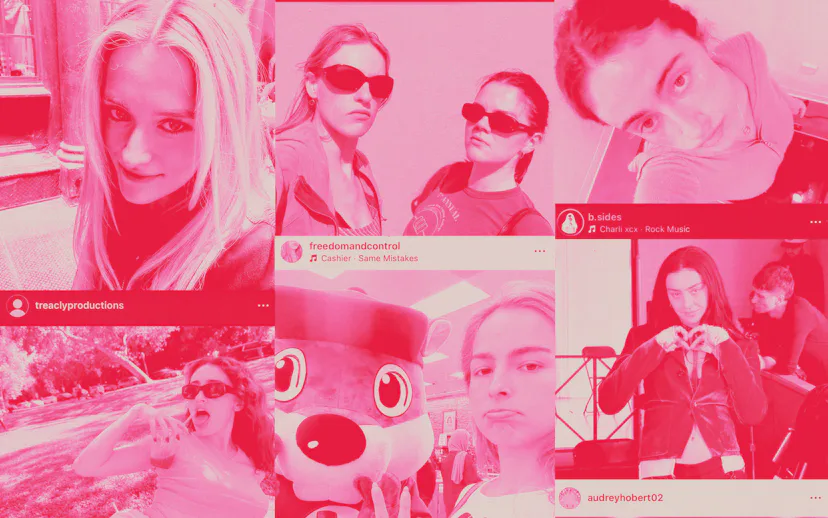
Over the past few months, a growing number of musicians, actors, designers, and who’s who have launched secondary Instagram accounts that feel suspiciously similar to the finstas many of us have maintained since high school. From Rachel Sennott’s free feet pics to Audrey Hobert’s Poot memes, Addison Rae’s head-scratchingly nondescript still lifes, and Zara Larsson taking over the closest thing to a collab finsta, these accounts aren't necessarily revealing major secrets so much as documenting the beautifully banal details that make up a personality. Even brands are buying in on the secondary account economy now; just last week, Balenciaga creative director, Pierpaolo Piccioli revealed @keeppprolling, strewn with exclusive Sarah Pidgeon selfies, behind-the-scenes dispatches, and the kind of seemingly random and unpolished ephemera that would never make it onto Balenciaga’s main.
Of course, calling these accounts "finstas" isn't entirely accurate. Traditional finstas were private by design, built for a carefully vetted audience of friends rather than hundreds of thousands of followers. Nobody was building a brand on their finsta. The entire appeal was that it existed outside the performance.
What these creatives are cultivating instead is something closer to a faux-finsta (ffinsta?): a public-facing account that mimics the aesthetics of intimacy without actually limiting access. The audience may be massive, but the goal is to make it feel small — but crucially, not too small.
These accounts don’t actually want to stay hidden. They want to be found, though not too easily or by everyone at once. There’s a new kind of social signaling at play here: the desire to appear like a private, in-the-know space while still letting the algorithm do what it does best, which is surface it to the “right” people. If you get it, you get it — and the platform will know where to find you.
Perhaps the clearest blueprint came from Charli xcx. Long before Music, Fashion, Film’s @b.sides, there was “360_brat”, the account that became essential viewing during the Brat era. It wasn't merely promotional, but functioned as an extension of the project's lime green, hyper-referential world-building by rewarding her inner-most circle of fans who wanted to dig deeper. Kicking off in summer 2024 (perhaps better known as “Brat summer”), exclusive BTS snaps of Charli and co. were posted to the grid, and time sensitive clues and cryptic updates were posted to the Instagram Story, including the coordinates leading to unspecified-events-turned-cultural-touchstone moments like the Brat Wall concert in Williamsburg. To be a “true fan” suddenly required participation (and the elusive follow request approval). You weren't simply consuming the campaign, but helping decode it.
That's increasingly what these celebrity "finstas" offer. Not access in the traditional sense, but context. While the main account delivers the polished, filtered artifact, the secondary account reveals the references, jokes, and screenshots that helped create it.
The irony, of course, is that the original finsta emerged as a refuge from self-branding — a place to escape the pressure of performing a version of yourself online. Today's celebrity finstas do the opposite. They're not a rejection of branding, but its latest evolution. It's no longer enough to simply make the work; audiences expect public figures to embody the world around it, too. The strongest personal brands today aren't selling a single flawless image so much as a fully realized, sometimes messy character complete with cultural literacy. And ladies and gentleman, the people want lore!
