Contributor Content
Yi Zhou’s Path To Hollywood: Writer, Director, Creative New Star
Yi Zhou’s work spans film, music, art and writing, drawing on a career that connects Shanghai, Rome and Hollywood.
There was a time when Hollywood’s definition of a rising star was relatively straightforward. A director created the movie that everyone was talking about, an actor got a breakthrough part, or an "It girl" emerged at the ideal cultural time. However, both the entertainment industry and the notion of what it means to be a creator have changed. Rather than fitting neatly into one category, some of today's most intriguing creative figures fall somewhere in between. Among them is Yi Zhou. In Zhou's creative life, the roles of creator, director, composer, author, and artist are more like various manifestations of the same impulse to create worlds and choose the best media to convey them.
Between Europe And Asia
Her journey to Hollywood doesn't fit into a conventional narrative. Born in Shanghai and raised in Rome, Zhou grew up between China and Europe, absorbing two dramatically different cultural environments from an early age. Her Chinese roots connected her to a country experiencing extraordinary social and technological transformation, while growing up in Italy immersed her in a European visual tradition shaped by art, architecture, cinema, fashion and design. Rather than choosing between those influences, Zhou learned to exist between them. That duality eventually became one of the defining characteristics of her work. Her perspective is neither exclusively Eastern nor Western, neither purely traditional nor purely technological. She has spent years moving between cultures, industries and creative languages, developing projects primarily across Europe and Asia before Hollywood became the latest chapter of that trajectory.
Europe provided an early foundation for Zhou’s artistic practice. Her creative world developed through contemporary art, visual culture, fashion, moving image and collaborations that allowed her to experiment without limiting herself to a single discipline. Asia, meanwhile, became another crucial part of her professional and creative development, particularly as China emerged as one of the world’s most dynamic environments for digital culture and technological innovation.
Over the years, she worked in creative and ambassadorial capacities with Chinese technology companies and digital platforms. Her work as a creative director and ambassador placed her at an unusual intersection between artist and technology, translating innovation into imagery, storytelling, cultural experiences and creative concepts. For Zhou, technology was never interesting simply because it was new. What interested her was what creative people could do with it. She has consistently approached technology as a creative instrument rather than a replacement for creativity. A new platform, camera, digital environment or artificial-intelligence tool becomes meaningful when it allows an artist to communicate an emotion or an idea in a new way.
That philosophy feels particularly relevant today. Hollywood is now confronting many of the same questions Zhou encountered earlier in her career in Asia: How will new technologies transform storytelling? What happens when audiences move between traditional screens and emerging platforms? How can creators preserve authorship while embracing tools capable of transforming production? And how does an artist remain emotionally recognizable in a culture increasingly shaped by algorithms? Zhou’s answer has been to embrace innovation without surrendering imagination. Her interest in technology naturally evolved toward experiments involving artificial intelligence, animation and new forms of visual storytelling. Rather than treating AI as a novelty, she sees it as part of a much longer creative continuum, another tool that can sit alongside film, photography, music, writing and digital art.
Film, Music And Authorship
The relationship between art and innovation is therefore not a recent pivot in Zhou’s career. It has been building for years, across continents, and now it is converging in Hollywood. Cinema may ultimately be the medium that allows the greatest number of Zhou’s interests to coexist. Film contains photography, performance, music, writing, fashion, production design and technology. For someone accustomed to thinking across disciplines, filmmaking offers an unusually expansive canvas.
Zhou’s recent body of work reflects that fascination. With In Between Stars and Scars: Masters of Cinema, she turned her attention toward the artists and craftspeople whose work creates the visual language of movies, exploring cinema through the people who shape what audiences ultimately experience on screen. That investigation continued with a follow-up Masters of Cinema project, expanding her exploration of cinematic imagination, craftsmanship and cultural memory. The project also highlights another increasingly important dimension of Zhou’s identity: music.
As a composer, Zhou sees sound not as something added to an image after the fact, but as another form of storytelling. Music can create an emotional memory that survives long after the audience has forgotten the specifics of a scene. It can transform images, create atmosphere and communicate what dialogue cannot. Music, for her, is not separate from filmmaking. It is part of the emotional architecture of a project, another language through which a story can be experienced.
One Story Across Several Media
That convergence between technology, cinema and authorship becomes especially visible in Stardust Future: Stars and Scars, one of Zhou’s most ambitious transmedia projects. Conceived as a universe rather than a single piece of content, Stardust Future moves across film, literature, music, visual art and emerging technology, reflecting Zhou’s belief that a story no longer needs to live within only one medium. At the center of the project is a pioneering AI-animated feature, conceived as an experiment in feature-length filmmaking using artificial intelligence as part of the creative process. Alongside the film, Zhou expanded the universe through the transmedia book Stardust Future, allowing characters, ideas and visual concepts to travel from the screen onto the page and creating different points of entry into the same imaginative world.
For Zhou, Stardust Future represents a natural evolution of ideas she has explored throughout her career. Her early experiences at the intersection of creativity and China’s rapidly evolving technology culture introduced her to the possibilities of new platforms. With Stardust Future, those interests come together: the visual artist, filmmaker, author, composer and technology-driven creator operating within a single universe. Rather than using AI simply as a technical effect, Zhou approaches it as another component of the creative vocabulary, a tool capable of expanding the scale and visual possibilities of an artist’s imagination while keeping concept, emotion and authorship at the center.

The transmedia structure is equally important. A film can become a book; a book can deepen a cinematic universe; music can establish its emotional identity; digital imagery can extend its visual mythology. Instead of thinking about film, publishing, music and technology as separate industries, Zhou sees them as interconnected forms of storytelling. Stardust Future embodies that philosophy perhaps more completely than any of her projects: a story designed to move between mediums and audiences while maintaining one creative vision. In that sense, the project offers a glimpse at the kind of creator Zhou is becoming in Hollywood. She isn’t interested only in directing an individual film and moving on to the next. She is interested in building worlds, and in exploring how cinema, literature, music, visual culture and emerging technologies can work together to make those worlds larger.
First Timers And Beginning Again
That philosophy continues with First Timers, her documentary series built around one deceptively simple idea: what happens when someone does something for the first time? The concept resonates strongly with Zhou because reinvention has been one of the constants of her own career. First Timers explores people entering unfamiliar territory, taking risks, beginning again or revealing another dimension of themselves. Its subjects come from different areas of film, music, culture, entrepreneurship and creativity, mirroring Zhou’s own resistance to remaining inside one professional category.

Beauty, fashion and visual storytelling
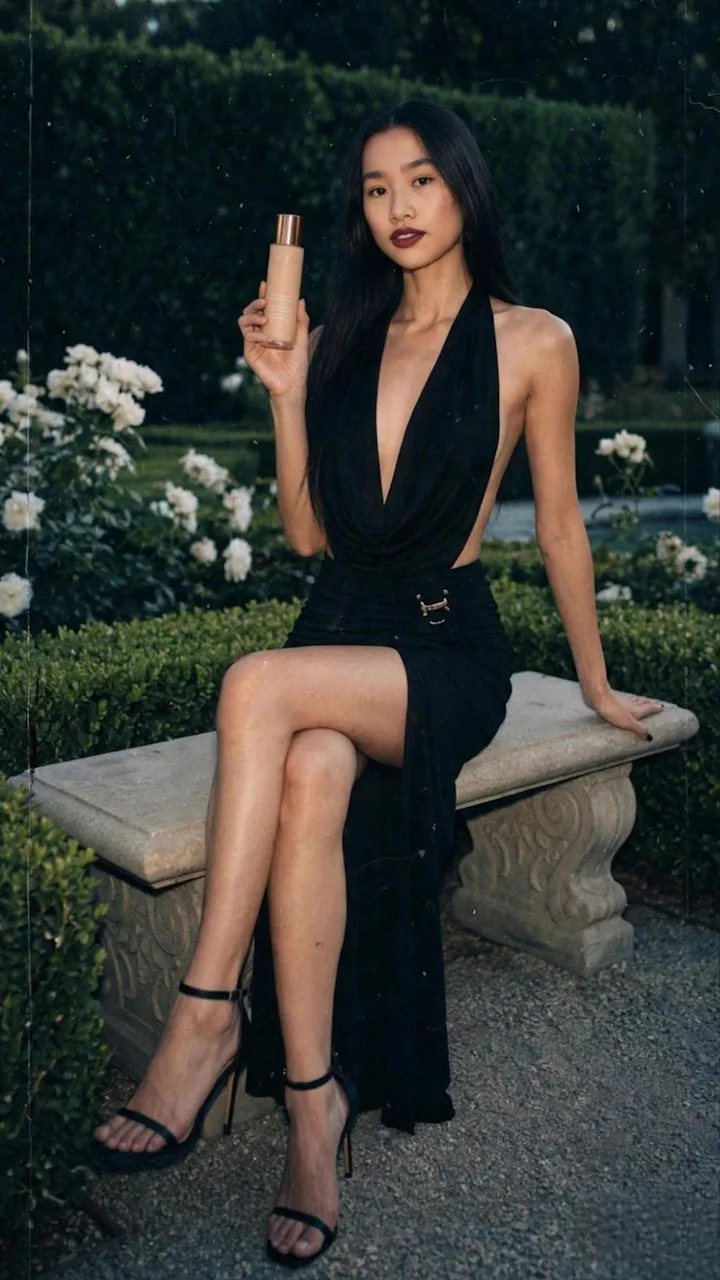
For Zhou, beauty can function as visual storytelling. A face, texture, silhouette, color or beauty look can establish character before a word is spoken. Fashion can communicate identity. Beauty can signal transformation. And on a red carpet, the person who once stood behind an artwork or camera can temporarily become part of the image herself.
Yet the glamour surrounding filmmaking is only one layer of Zhou’s creative identity. At the center of everything is authorship. As a director, she constructs cinematic worlds and determines how an audience enters a story. As a composer, she thinks about the emotional architecture underneath those images. As an author, she works with perhaps the most elemental storytelling material available: words. And as a creator, she refuses to believe those roles must remain separated.
That makes the familiar “It girl” label simultaneously tempting and inadequate. Zhou understands the visual codes of fashion, celebrity and image-making. She can occupy the red carpet as comfortably as the creative spaces surrounding production. But the more interesting part of her trajectory is what happens behind the image. She wants to create it. That distinction may define the next generation of Hollywood creative figures.

Working across creative disciplines
The old entertainment system was built around specialization. Actors acted. Directors directed. Composers composed. Writers wrote. Artists belonged in galleries. Fashion existed in another ecosystem. Technology companies built tools while entertainment companies created content. Those boundaries have become increasingly porous. A film can become a soundtrack, a social-media universe, an immersive experience or an AI-powered extension. A director can simultaneously be a creator, composer and author. A musician can become a filmmaker. An artist can use software as readily as paint. Zhou’s career has developed naturally inside that convergence.
Hollywood has always been fascinated with reinvention, but today reinvention is happening to Hollywood itself. Artificial intelligence is changing production. Streaming is one way films and series reach audiences. Social media has dissolved much of the distance between creators and audiences. International entertainment markets increasingly influence what becomes globally relevant. Fashion, beauty, music, film and technology now circulate through the same cultural ecosystem. The creator capable of navigating that world may look very different from the Hollywood star of previous generations.
That may ultimately be what distinguishes Zhou’s current moment. There's ambition in her Hollywood trajectory, sure, but there's also a sense that cinema is part of something broader. As a creator, director, composer, author and artist, she is developing a creative language that can travel beyond mediums and boundaries. One word isn’t enough to describe her.
Her career crosses boundaries that formerly separated cultures, mediums and industries, from Shanghai to Rome, from projects spanning Europe and Asia to a new chapter in Hollywood. The path is universal, but the concept behind it is simple: be curious enough to start again.
BDG Media newsroom and editorial staff were not involved in the creation of this content.
