NYLON House
Ellie Goulding Has Something To Say
After getting divorced, rediscovering her spark, and finding new love, she’s feeling her new music like never before: “I believe in my writing — if you don’t, people know.”
Ellie Goulding is fully on board with the 2016 nostalgia unfolding across our feeds. “2016 being my best year, I have no qualms with this dumb trend… you know I had to,” she wrote on Instagram alongside a carousel of star-studded throwback pics (Lorde! Kendrick! Elmo!). Back then, her blockbuster third album, Delirium, was pumping out hit singles like “Something in the Way You Move,” “On My Mind,” and “Love Me Like You Do.” She headlined an 88-city world tour and played all the major festivals. She even got her very first Grammy nomination, for best pop solo performance. By 2017, she slowed down for her own sanity, but the culture always finds its way back to Goulding — every few years, to her delight, an old hit of hers goes viral on TikTok. (In 2022, it was a sped-up version of “Lights”; currently, it’s “Starry Eyed.”) As she readies a new album for later this year, her first since 2023’s Higher Than Heaven, it’s clear: In 2026, it’s still good to be Ellie Goulding.
When we meet for breakfast in Miami in early December 2025, it’s the peak of Miami Art Week. Goulding, dressed down in a baseball hat and sweats, has just flown in from London, where she announced she’s expecting a baby with boyfriend Beau Minniear and showed off her new bump at the Fashion Awards’ red carpet. (Goulding also shares a son, Arthur, with ex-husband Caspar Jopling.) The day after our hang, she’ll take the stage for a surprise performance at our annual NYLON House party, inciting a full-audience scream-along while wearing a figure-hugging mesh dress. For Goulding, growing her family and getting her bag can happily coexist.
“I didn’t want to become just a pregnant woman first,” she says. “Not every woman has this luxury. I have amazing people around me. I have an amazing boyfriend. I do have it a little easier in that I do have amazing support. I’m still working every day and still writing every day. It’s just that I am growing a human inside me. I’m perhaps not the most, like, Mother Earth about it, if you know what I mean? It’s a beautiful thing to be able to grow a child, and I feel very lucky that I’m healthy — but it’s not all I am right now.”
That expansiveness is leading to some of the most honest and raw music of her career, she says. In November, Goulding released “Destiny,” a stirring reclamation of her sensual side that serves the first taste of her next album, written in the immediate aftermath of her divorce from Jopling and the beginning stages of falling in love with Minniear (who also appears in the song’s steamy music video). But anyone who’s followed Goulding’s career knows she’s never been shy about putting it all out there. “I like to talk,” she says, nonchalant about just how actually-chalant she is. (Indeed, the first time I met her at a black-tie fashion gala in London last year, I was struck by how she seemed like one of the only guests interested in having a real, unguarded conversation.) Over a bread basket and plate of fruit, we had a long chat about the burnout that threatened her career, the new rules of pop, and why everyone’s hungry for a “divorce album.”

It is so hot outside right now! Are you a Miami girl?
I come here a lot. I know that if I come here, I will get sun, but I will also be productive, I’ll go work out, I’ll eat healthy — and generally just be around really good people. It feels detached from reality, in a good way. But I am attached to London in a big way. My son goes to school there.
How old is he now? Four?
Four, yeah. He did a school play today, which I just missed, sadly, but his grandparents went. The last play [the school] did, he was so shy that he didn’t want to do it. And then this time around, he’s been practicing his lines. I was so proud because everyone’s like, “Oh, maybe Arthur didn’t get the performing gene.” But I was also really, really shy as a kid. In fact, the only time that I was not shy was on stage.
Really? How did you get yourself to even go on stage?
I would just quietly enter myself into school plays. As soon as I got on stage, that’s what I was supposed to do. At times in my life, I wanted to be a journalist, I wanted to be a boxer, I wanted to be other things. But singing never went away. I was definitely musical — I played clarinet, I played piano, I played recorder, which is the most annoying sound in the world — but my voice was really unusual and strange, so I wasn’t the likely candidate for the main character of a play or a performance. I was always in the background chorus. But as I went on and taught myself guitar, I did find my voice turning into something.
“I started getting panic attacks, to the point where I couldn’t leave the house. If you were trying to make it as a female singer, you had to do everything.”
When did you realize that you had such a unique singing voice? Did someone point it out?
I always remember this one conversation. This guy came up to me and said, “You’re a really good guitarist, but the voice… you should focus on guitar.” And it floored me. He was a musician, and I really looked up to him, so I was like, “Well, that’s it then.” And I remember he came up to me a year later and was like, “Good to see you, how are you? How’s things? Are you still singing?” I was like, “No, I stopped.”

That’s brutal. How old were you at this point?
I was 17. That one comment just threw me. It was only when I got to university that I found people that had grown up listening to singers like Björk and Imogen Heap and more distinct voices. That changed things. It felt like people were seeing me for the first time.
You eventually left uni to pursue your music career full time. Do you ever think about that as a Sliding Doors moment for you?
I come from a working-class background, so I was like, “Maybe I should just sing as a hobby.” But I chose the hard way and decided to go live by myself in this random room in someone’s house in London, and write during the day. It was a very solitary existence. I didn’t have any friends. I was still this shy, anxious person. I would go to the gym, run 10K every morning, go back to the studio all day and write. It was probably the loneliest time of my life. Eventually, I sat down with this guy Ferdy Unger-Hamilton, who ended up signing me. By the time I met him, I was two years into trying to convince someone that I was worthy of signing. All these singers that you think just come out of nowhere, like Olivia Dean, they were working their asses off for years.
Exactly — sometimes people forget that.
So I went from that to being on TV, getting the Brit Award, getting the BBC Sound Of award. I was thrust into this mad life, and that happened in a few months. It was the wildest time of my life.
“People don’t want fake. They don’t want characters. They don’t want somebody inauthentic. Our only option now is to be ourselves.”
Were you able to process how much your life was changing?
It was impossible. I went straight from that to going on tour with Little Boots, then Katy Perry, then Bruno Mars. My body wasn’t catching up with my head, or maybe the other way around. I started getting panic attacks, to the point where I couldn’t leave the house. I’d get in the car and the landscapes were triggering me, so I’d have to cover my face. And so I was like, “Well, I need to do something about this.”
I went from never taking a flight, never being photographed, to singing at the royal wedding. I don’t think my body knew how to process the contrast between my old life and my new life, and I don’t think I was equipped to deal with that amount of scrutiny, attention, and workload. I never stopped. Literally yesterday, one of my best friends just met my boyfriend, and he was telling Beau that one time he had to intervene because I was going straight from one thing to another. If you were trying to make it in music as a female singer, you had to do everything.
Because you felt pressure to say yes?
Totally. Meanwhile, my body physically couldn’t function well, and my throat was dead. I kept getting tonsillitis, I kept getting sick, and there was nothing in place then to ensure that I was OK. There were a couple of big things, like an awards performance, where I had to say no because I physically couldn’t do it. And I remember them being like, “You’ll never be able to perform [at the show] again.” I was like, “Well, what do you want me to do? Do you want me to have to die?” There were things like that: “If you don’t do this, you will get repercussions.”


That is a lot to have on your shoulders.
God, you’re making me think of all the things that I’ve been like, “I can do this!” Coachella one year, I had food poisoning. I was sh*tting my pants, and I still went. I had these leather shorts that had a zip up the back and front, and I thought, “These are the worst thing for my situation right now.” I’d been performing in South America — with Lorde, actually — and I got food poisoning. I remember having dinner with Ella, and I had some kind of wrap and it all went wrong. But again, I do feel now there is more in place to ensure that we’re OK.
We’re seeing it now with Lola Young — she had that very scary moment at All Things Go, and it does seem like her team has given her the time and space in the aftermath to take care of herself.
I was thinking of that. Nothing can equip you for that rise to fame. I feel like [Lola]’s doing the right thing. She’s clearly got good people around her. She’ll come back. She’s extremely talented. She’s a great writer. It’s not like, “Oh, she can’t handle the fame." It’s just a recalibration: This is what the experience is like. I needed a break from it, and now I’m going to come back more ready for it.
That kind of vulnerability around fame used to be seen as a weakness.
I remember in the early days, when I did a bunch of interviews — I’m a really open person. I like to talk about my background and how a lot of my writing came from pain and trauma and my inner demons. To then be told like, “You’re saying too much”? I was made to feel like you’ve got to be this strong character. You’ve got to be a role model. So I started censoring myself. Once I released “Burn,” it was like, “OK, this is your box: ‘You are a girl next door, you’re blonde, you’re pretty, you wear makeup and shorts.’” So I’m really happy that that has been undone. Seeing Addison Rae do a promo tour with no makeup on was just the most refreshing thing in the world. Even the idea of me coming down to do an interview with you with my sweats was just unheard of in the past.
I am grateful that my label is very cooperative with me no longer wishing to play that character anymore. I do feel like in this new age of vulnerability, labels still want to make money and still want to sell records, but thankfully it’s in our favor now. People don’t want fake. They don’t want characters. They don’t want somebody inauthentic. Our only option now is to be ourselves and to write exactly what we want to write about without feeling like we’re giving too much, or we’re being too much.
“I didn’t know it was going to be a divorce album, but that’s the way it started heading.”

Do you ever get whiplash from the way the tides change like that?
The landscape has changed so much, but what I always believe squashes all of that cynicism is the power of music — regardless of how little or how much I’m giving away, we still all rely on that. I relied on music to get through my divorce. I listened to classical music walking through the park every day thinking, “What am I doing?” The soundtrack to our lives will never go away. I rely on the purity of that to take away some of my cynicism.
How does that show up in the new music?
It was taking it back to basics for me, going back to instruments — which is so rudimental, but AI music is on the rise, working from your laptop is on the rise. I took it back to the guitar, which is where I first started. It aroused something in me that was innocent and pure from when I was 15, writing my first song. That was number one. Number two was working with [producer] Jack Rochon and just the joy of collaborating, the joy of being in a room with people who are all a bunch of nerds.
I worked with Kiddo A.I. [Amanda Ibanez], who works with Selena Gomez and Lisa and has a real balance of poetry and colloquial, modern expressions, as well as Steph Jones, who worked a bunch with Sabrina [Carpenter]. I’d tell her what had happened with me in my marriage and she just had a way of wording it. It made me realize I just have to find this pocket between metaphorical, symbolic writing and just straight-up real talk.
“There were some songs that were extremely reactionary and sad that felt good to do in the moment but don’t serve me long-term.”
When you started going into the studio, were you like, “I need to get some stuff out of my system”?
It had always been the goal to start this album. I didn’t know it was going to be a divorce album, but that’s the way it started heading. I would write things down, lines from poems or books. I was reading things to make me laugh, like Nora Ephron and Deborah Levy. I read Lisa Taddeo. I was just writing little things down that resonated with me. I had a baby and, again, talking about women just being expected to be equipped to deal with this sh*t all the time — I was not equipped to deal with the aftermath of suddenly being a mom and having to carry on like nothing’s happened. You brought a life into this world, and it’s changed your brain makeup and changed your body, and you just got to go on as if it’s nothing. So that, plus the fact that I knew that my marriage wasn’t working out, it was dark times… The day I met Jack was the day I was like, “Jack, I should be candid with you. Today, my husband and I decided we’re going to separate.”
It’s so funny that the process over the years is so indicative of how I was feeling at the time. The songs have gone from so dark and angry, to cynical, to funny, to coming out the other side, to meeting a new guy and being excited.


How many songs do you think you wrote for this project?
50? 60? I have a folder of songs that maybe won’t make the album. They’re just there. I’ve gotten to a point with some where I don’t need to put it out or it’s too sad for even me to sing anymore.
Especially being in this happy new relationship, were you ever like, “Let me just scrap the divorce stuff,” because you’re so past it?
When I married my ex-husband, I thought it was for life. That will never go away and that will always stay with me. There are some songs that are necessary for me to acknowledge that time in my life and to be respectful of it. Then there were some songs that were extremely reactionary and sad that I felt were good to do in the moment but don’t serve me long-term.
“My label, my friends — everyone’s behind it. And even my ex-husband loves the songs.”
Now that you’re on the other side: Are we getting what you would call a “divorce album”?
I asked my friends about this. I sent them a folder of the songs and was like, “What do you guys think?” I trust my friends, and they’re real music lovers. One person said, "Wow, this is the divorce album.” And then most of the others were like, "This just sounds like you’re a new woman. It sounds like growing and rediscovery. It doesn’t feel like divorce.” I don’t think that divorce has to have this negative connotation anymore. We’re lucky to be in a position where we don’t have to be married and we don’t have to necessarily rely on somebody. I really like that most of them clearly picked up in the writing that it’s about something else.
I think the term “divorce album” is also just at the tip of everyone’s tongues following West End Girl.
Yes. [Lily Allen and I], we came up at the same time. I actually saw Lily the other day randomly in the cinema. I always thought she was a poet, a lyricist. She’s got a really great voice, but I felt like her thing was to be a storyteller. I also like to think myself a storyteller, but I like seeing myself as a vocalist.

Are you feeling anything ahead of this new music that you haven’t in past albums?
Honestly, a complete lack of expectation, which is so liberating. I’m like, “I believe in this music. I believe in my voice. I believe in my writing.” If you don’t, people know. Fans know. Higher Than Heaven, I didn’t really believe in it. I released it in a kind of post-pandemic panic. It was just an album of nice songs. Everything around it was beautiful, dressed up real nice. But the actual album, it didn’t even land for me, so how did it land for my fans? Whereas this one, I was fully behind.
It lands.
And it feels new. It feels different, this feeling of finally going to a place and releasing something and I don't feel any pressure. My label, my friends — everyone’s behind it. And even my ex-husband loves the songs.
Now that’s a mic-drop of an ending.
Well, he hasn’t heard all the songs.
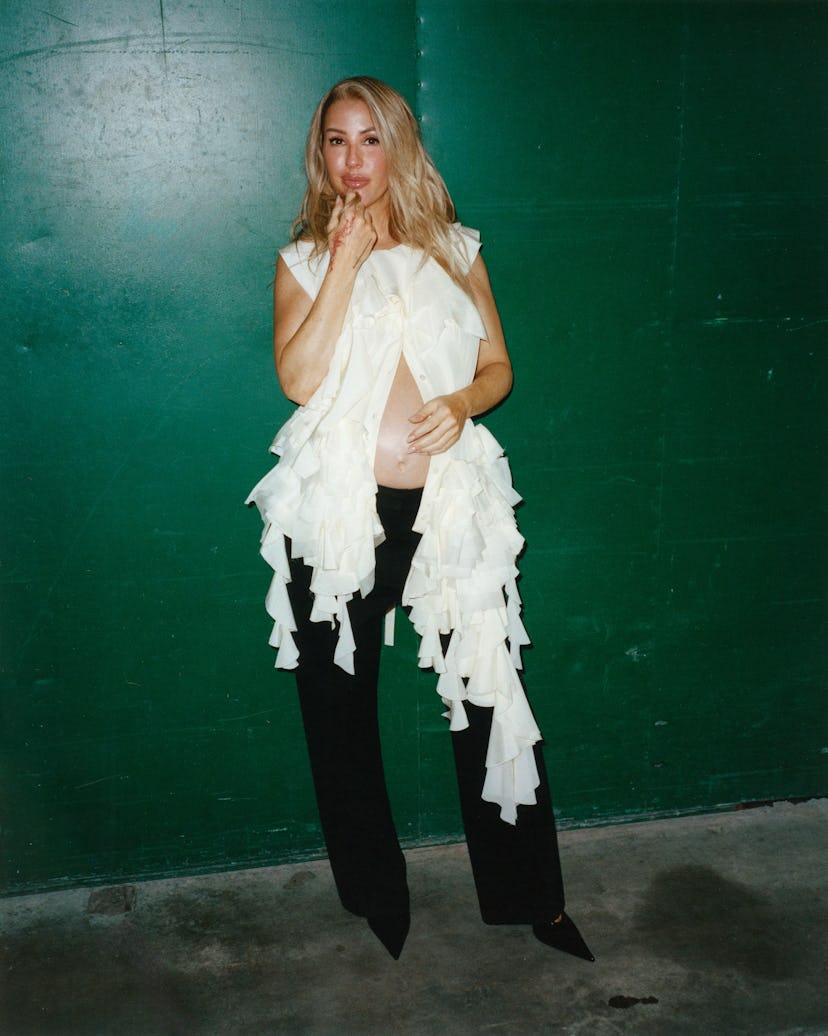
Top image credit: McQueen top, COS pants,Amina Muaddi shoes
Photographer: César Buitrago
Stylist: Omar Thomas
Writer and Editor-in-Chief: Lauren McCarthy
Creative Director: Karen Hibbert
Hair: Dafne Evanglista
Makeup: Bo
Photo Director: Jackie Ladner
Production: Michael Wysocki, Danielle Smit
Fashion Market Director: Jennifer Yee
Fashion: Stephanie Sanchez, Ashirah Curry
Location: Riverset Studios
Features Director: Nolan Feeney
Social Director: Charlie Mock
